
In the SCHD vs VYM debate, SCHD fits long-term investors who want more income now from roughly 100 quality-screened companies. VYM suits investors who want broad diversification across roughly 600 dividend payers, a slightly lower fee, and steadier sector weights from year to year.
Quick verdict: Pick SCHD for higher income now (3.04% yield) from about 100 financially screened companies. Pick VYM for broader diversification (593 holdings), a lower 0.04% fee, and a smaller tax bill in taxable accounts.
Key Takeaways
- SCHD filters companies for debt coverage, profitability, yield, and dividend growth before it buys anything.
- VYM simply holds the higher-yielding half of the large U.S. market, weighted by company size.
- SCHD’s higher yield produces about $760 more first-year income per $100,000 invested.
- VYM’s lower yield creates a smaller annual tax bill in a taxable brokerage account.
- SCHD rebuilds its portfolio every March, so its sector mix can swing sharply between years.
What Are SCHD and VYM?
SCHD and VYM are index ETFs that own baskets of dividend-paying U.S. companies, run by Charles Schwab and Vanguard, respectively.
SCHD started in 2011; VYM began in 2006. Both pay quarterly, both exclude real estate investment trusts, and both cost less than a dime per $100 invested each year.
SCHD vs VYM: How Do the Two Funds Compare Side by Side?
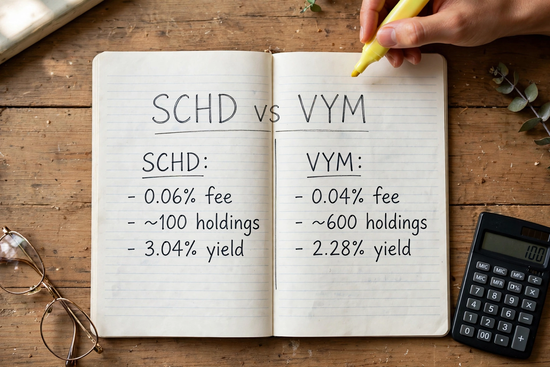
SCHD offers a higher yield and a concentrated, quality-screened portfolio. VYM answers with a smaller fee and much broader diversification.
| Feature | SCHD | VYM | Source |
| Expense ratio | 0.06% | 0.04% | SCHD: Schwab Asset Management; VYM: Trackinsight |
| Number of holdings | 102 (Oct. 21, 2026) | 593 (Sept. 30, 2026) | SCHD: Charles Schwab ETF Research; VYM: Trackinsight |
| Trailing 12-month yield | 3.04% | 2.28% | ETF Central, both as of Oct. 21, 2026 |
| Index | Dow Jones U.S. Dividend 100 | FTSE High Dividend Yield | — |
| Weighting | Market cap, 4% cap per stock, 25% cap per sector | Market cap, no index-level caps | — |
| Mutual fund twin | None | VHYAX, Admiral Shares | — |
On a $25,000 position, SCHD’s fee costs $15 a year and VYM’s costs $10. That $5 gap is trivial next to the 0.76-point yield gap, which hands SCHD holders about $190 more each year.
How Do SCHD and VYM Choose Their Holdings?
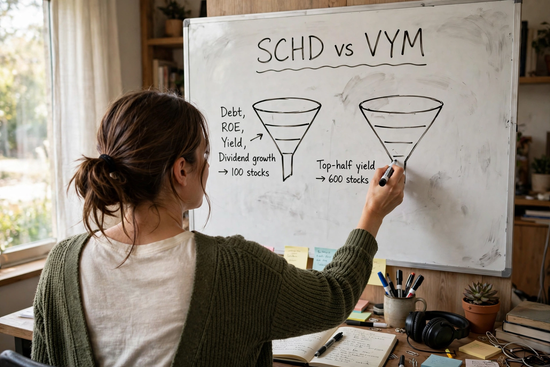
SCHD screens for financial strength first and yield second, while VYM ranks almost entirely by yield. That one design choice drives most of their differences.
SCHD’s four-factor screen
SCHD’s index starts with U.S. companies that have paid dividends for at least 10 straight years. It keeps the higher-yielding half, then scores each survivor on cash flow to total debt, return on equity, dividend yield, and five-year dividend growth.
The top 100 scores make the cut. A company with a juicy yield but heavy debt or shrinking profits usually fails before it ever enters the fund.
VYM’s yield ranking
VYM’s index ranks U.S. large- and mid-size companies by forecast 12-month yield and keeps those in the upper half of the market by value. It applies no profitability or debt test.
Because a published rulebook, not a manager, decides every holding, both funds are passive investments. If you’re comparing this approach with picking shares yourself, our guide to passive stocks explains how rules-based investing keeps costs and guesswork low. VYM’s rulebook carries a yield-trap risk: when a company’s share price collapses, its yield rises, so VYM can keep holding it until the index’s next review or until analysts lower their dividend forecasts. SCHD’s debt and profitability screens often catch those companies first.
Which Fund Pays More Income Over 10 Years?
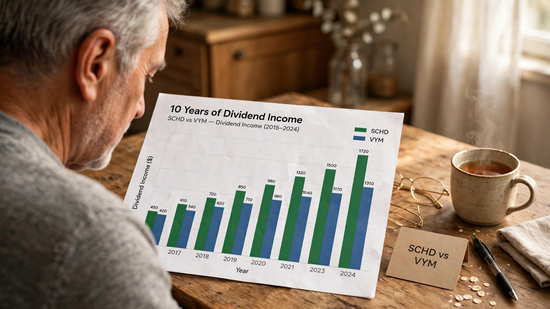
SCHD pays more in most realistic scenarios because it starts with a higher yield. Dividend growth rates change every year, so this projection uses assumptions you can swap for your own.
- Put $100,000 into each fund and spend the dividends instead of reinvesting them.
- At trailing yields, year-one income comes to $3,040 from SCHD and $2,280 from VYM.
- Assume SCHD grows its payout 8% a year and VYM grows 5%, roughly in line with each fund’s recent dividend growth. These are illustrations, not forecasts.
- By year 10, SCHD pays about $6,077 a year and VYM pays about $3,537.
- Across the decade, SCHD delivers roughly $44,040 against VYM’s $28,680, a gap of about $15,360.
Flatten the assumption and SCHD still wins. At an identical 5% growth rate, its head start alone adds about $9,560 over ten years.
Income is only half of total return, though. To see the full picture, compare the two funds on a total-return chart with dividends reinvested. If you’re new to charts, our guide on how to read a stock chart for beginners walks you through price lines, total-return views, and what each one tells you.
How Does SCHD’s Annual Reconstitution Change What You Own?
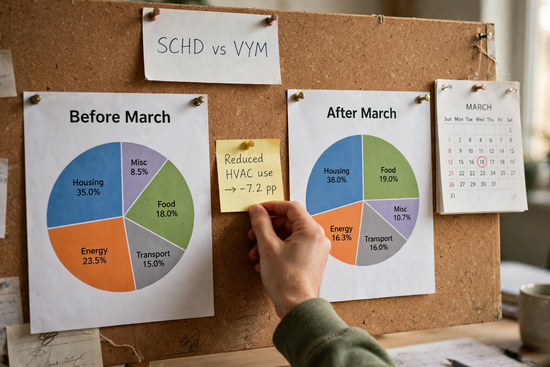
Every March, SCHD’s index reruns its screens and swaps out companies that no longer qualify.
According to Schwab Asset Management, SCHD held 23.5% of its assets in energy before the March 2026 reconstitution and 16.3% afterward. On a $50,000 stake, roughly $3,600 left oil and gas producers without you placing a single trade.
That rotation follows the rules rather than breaking them, but it means SCHD carries sector bets you never chose. Because the holdings change every March, check current sector weights each April. 5starsstocks .com tracks updated dividend ETF holdings and sector weights, so you can see what SCHD owns after each reconstitution.
What Should You Check Before Buying Either Fund?
Check five things on the issuer’s own page.
- Expense ratio. Both rank among the cheapest dividend ETFs, so cost alone rarely decides this matchup.
- Top 10 weight. SCHD’s largest positions carry far more of the fund than VYM’s, which raises single-company risk.
- Sector mix. Compare each fund’s weights against what you already own to avoid doubling a bet.
- Turnover. According to Schwab Asset Management, SCHD’s portfolio turnover rate stood at 41.96% as of May 31, 2026. Roughly two of every five dollars changed hands within a year, which makes old holdings lists unreliable.
- Tax fit. At a 15% qualified-dividend rate, $100,000 in SCHD generates about $456 in yearly tax versus $342 for VYM.
When you buy individual shares, knowing how to research a stock before buying is essential: earnings, balance sheets, and dividend history all matter. With an ETF, you apply that same thinking to the index rules instead. Read the methodology summary once, and every future change will make sense.
Which Fund Should You Choose for Your Goals?

Choose SCHD if you want more income now and can tolerate yearly sector swings. Choose VYM if you want the widest dividend net at the lowest cost.
- Drawing income within 10 years: SCHD’s higher starting yield fills a withdrawal budget faster.
- Reinvesting for decades: VYM’s breadth and lower fee make a simple core holding, with less risk tied to one sector or a handful of names.
- Taxable account, high bracket: VYM’s lower yield trims the yearly tax drag.
- Automatic investing at Vanguard: VYM’s mutual fund twin, VHYAX, lets you buy exact dollar amounts.
- Roth IRA: taxes drop out of the decision, so pick on income needs alone.
Investors poured $24.28 billion into SCHD during 2026 through October 21, compared with $4.43 billion for VYM, according to ETF Central. SCHD drew about 5.5 times as much new money, yet popularity says nothing about your timeline.
If you prefer owning individual companies, our list of the best dividend stocks for long term holding covers picks that share SCHD’s focus on strong cash flow and steady dividend growth. If you’d rather own dozens of them through one ticker, either fund does the job.
One exception flips the usual advice. If most of your portfolio already sits in an S&P 500 or total-market fund, you own heavy technology exposure, and VYM’s uncapped weighting adds more large tech dividend payers; SCHD’s screens and 4% cap pull in fewer of them, so it diversifies an index-heavy portfolio better, even for investors who would otherwise prefer VYM’s breadth.
FAQ
Is SCHD better than VYM for retirement income?
SCHD usually produces more retirement income because it starts with a higher yield. Retirees who rely on withdrawals gain the most, provided they accept a portfolio that reshuffles every March.
Can I own both SCHD and VYM?
Yes, you can own both, but their shared exposure to large dividend payers limits the extra diversification. A 50/50 split at trailing yields produces a blended yield of about 2.66%.
Does VYM pay monthly or quarterly dividends?
Both VYM and SCHD pay dividends every quarter, so you’ll typically get payouts in March, June, September, and December.
Are SCHD and VYM dividends taxed as qualified dividends?
Most dividends from both funds count as qualified, so they get taxed at 0%, 15%, or 20%. To qualify, you must hold shares more than 60 days during the 121-day window that starts 60 days before the ex-dividend date.
Which has better long-term growth, SCHD or VYM?
Neither fund wins every period, because results depend on which sectors lead the market. Energy and consumer staples rallies tend to favor SCHD, while strong runs in banks and large tech dividend payers tend to favor VYM.
Conclusion
The SCHD vs VYM choice comes down to income and quality screening versus breadth and simplicity. SCHD gives long-term investors a higher starting yield from financially strong companies, while VYM gives them nearly six times the holdings at an even lower fee. Pick the fund that matches when you need the cash, then hold it long enough for dividend growth to compound.