

What happens when a stock splits is simple math: the company multiplies its share count and divides the price by the same ratio, so your total holding keeps its value. You end up with more shares, a lower per-share cost basis, smaller per-share dividends, and normally no tax bill.
Quick formula: New shares = old shares × split ratio. New price = old price ÷ split ratio.
Key Takeaways
- A forward split raises the number of shares you own and lowers the price of each share by the same factor.
- Market capitalization, the price-to-earnings ratio, and the dollar value of your position stay the same on the split date.
- Your cost basis per share gets divided by the split ratio, while your total cost basis does not change.
- Dividends per share shrink in proportion, so the cash you receive stays level unless the board also changes the payout.
- A reverse split combines shares instead and often signals a company defending its exchange listing.
What Is a Stock Split?
A stock split is a corporate action in which a company changes its number of shares in a fixed ratio, adjusting the price of each share without changing the company’s total worth. A forward split adds shares, and a reverse split combines them.
What Happens When a Stock Splits, Step by Step?
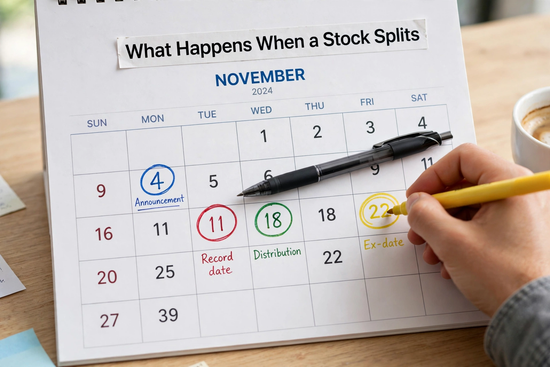
Your broker credits the new shares on a set date, and the quoted price drops by the split ratio the next trading morning. You take no action.
1. The split runs on a fixed calendar
Every split moves through four dates, and the order matters if you trade nearby.
- Announcement date: the board approves the split and publishes the ratio.
- Record date: shares you hold at that day’s close qualify.
- Distribution date: the company delivers the extra shares after the closing bell.
- Ex-date: the stock opens at the adjusted price, usually the next trading day.
In Netflix’s 10-for-1 split, anyone holding shares on November 10, 2025, got nine extra shares for every one they owned. Split-adjusted trading kicked off November 17, 2025, according to the company’s October 2025 split announcement. Sell inside that one-week gap, and your buyer, not you, receives the new shares through an IOU called a due bill, which brokers settle automatically.
2. You own more shares, each worth less
Your share count multiplies by the ratio while the price divides by it, so the product stays constant.
A 2-for-1 split turns 50 shares at $300 into 100 shares at $150, still $15,000. Own 25 shares in a 3-for-2 split, and you get 37.5; most brokers pay the half share in cash, and that small cash payment is taxable.
Whole shares still matter for options and some brokerage plans. Splits also help with a common question: how many stocks should a beginner own?With lower share prices, a $2,000 account can hold 10 to 20 whole-share positions instead of two or three, which makes diversifying much easier.
Does a Stock Split Change a Company’s Value?

No. Think of a split as cutting the pie differently: the pie itself stays the same size, so market cap doesn’t budge right when it happens.
3. Earnings per share and P/E adjust together
Earnings per share fall by exactly the same ratio as the price, which leaves the price-to-earnings ratio untouched.
Walmart’s 2024 split lifted its outstanding share count from roughly 2.7 billion to roughly 8.1 billion, per the company’s January 2024 announcement. Triple the shares and EPS falls to one-third: a $600 stock earning $20 trades at 30 times earnings, and after a 3-for-1 split, $200 against $6.67 is still 30 times.
This is useful if you screen stocks by valuation. what is a good P/E ratio for a stock Whatever benchmark you use, the answer stays the same before and after a split, because price and profit shrink together.
Why Do Companies Split, and Do Prices Rise Afterward?
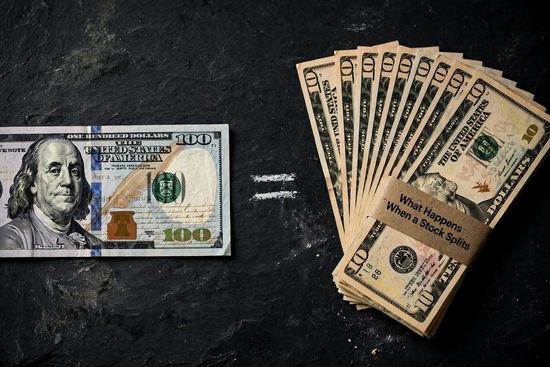
Companies split mainly to bring a high share price back into a range employees and individual investors can buy in whole shares. Prices often rise afterward, but the split itself is a signal, not the cause.
4. A lower price is not a discount
A $100 share after a 10-for-1 split costs exactly what a $1,000 share cost before it. The real motives are payroll stock purchase plans, tighter bid-ask spreads, and the price-weighted Dow Jones Industrial Average, where a four-figure stock would carry outsized weight.
Stocks that split returned an average of 25% over the next 12 months, against 12% for the S&P 500, according to Bank of America research published in May 2024. That 13-point gap compares split stocks with the whole index over the same windows, not with similar high-momentum stocks that skipped a split. Boards usually split after long rallies, so the best stocks of recent years dominate that sample, and momentum explains more of the gain than the new share count.
How Does a Stock Split Affect Dividends, Cost Basis, and Taxes?
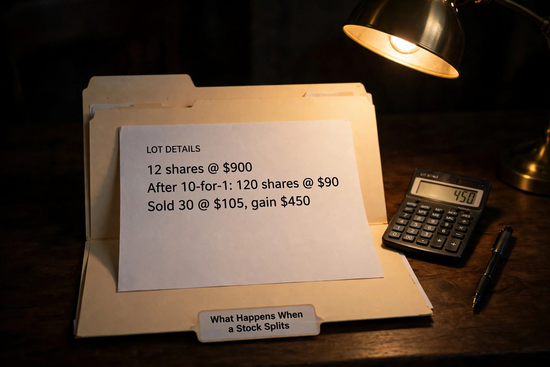
Dividends per share and cost basis per share both shrink by the split ratio, while your total income and total basis stay level. A standard forward split is not a taxable event under federal rules.
5. Dividend checks stay the same size.
The per-share payout resets to fit the new share count, so your quarterly cash changes only if the board separately raises or cuts it.
Nvidia paired its 2024 split with a dividend increase from $0.04 to $0.10 per pre-split share, equal to $0.01 after the split, according to the company’s May 2024 Form 8-K. An owner of 50 pre-split shares would collect $5.00 a quarter at the new rate; the identical $5.00 arrives on 500 post-split shares at a penny apiece.
Dividend ETFs aren’t affected either. If you’re weighing SCHD vs VYM, a split by one of their holdings changes neither fund’s share price nor its yield, because the fund simply owns more shares of that company at a lower price.
6. Your cost basis gets divided, and no tax is due
Divide your original per-share cost by the split ratio and keep the total cost unchanged. You owe tax only when you sell.
Say you bought 12 shares at $900, a $10,800 total basis. After a 10-for-1 split, you hold 120 shares at a $90 basis each. Sell 30 of them later at $105, and your taxable gain is $450 ($3,150 in proceeds minus $2,700 in basis). Transferred or very old lots sometimes show a zero basis, which would report all $3,150 as profit, so check your lot details.
Which Recent Stock Splits Show the Pattern?
Recent large splits came from very different industries, from an AI and a streaming service to an auto parts chain. The trigger is a high share price, not the business model.
Recent major stock splits, 2024–2025
| Company | Sector | Split ratio | First split-adjusted trading day | 100 shares became | Source |
| Walmart | Consumer retail | 3-for-1 | Feb. 26, 2024 | 300 | Walmart Inc. press release |
| Nvidia | Semiconductors | 10-for-1 | June 10, 2024 | 1,000 | NVIDIA Corporation Form 8-K |
| O’Reilly Automotive | Auto parts retail | 15-for-1 | June 10, 2025 | 1,500 | O’Reilly Automotive Form 8-K |
| Netflix | Streaming / media | 10-for-1 | Nov. 17, 2025 | 1,000 | Netflix press release |
Steady staples businesses split too, because years of slow compounding push a share price high just as surely as a sudden rally.
What Is the Biggest Mistake Investors Make Around a Split?
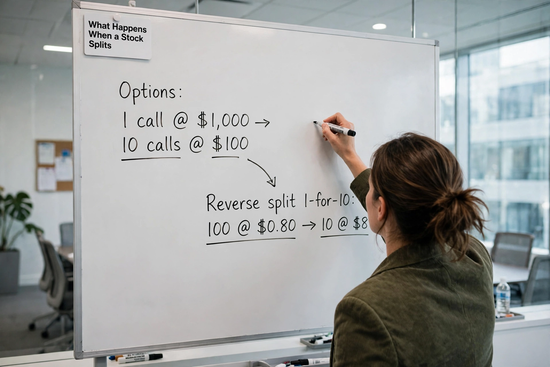
The most frequent error is buying because the new price “looks cheap,” followed by forgetting open orders and options.
A good habit is to follow split announcements and key dates on a dedicated tracker such as 5starsstocks .com , then check the numbers yourself: compare market cap and forward P/E before and after the split. If those didn’t move, neither did the value.
7. Open orders and options get adjusted
Options contracts are rewritten so the total position keeps its economic value. For whole-number splits like 10-for-1, one call with a $1,000 strike on 100 shares usually becomes ten calls with a $100 strike.
Standing orders depend on your broker; some cancel good-til-canceled orders while others adjust them, so read the corporate-action notice.
The big exception is a reverse split, where the usual “nothing changes” advice falls short. A 1-for-10 reverse split turns 100 shares at $0.80 into 10 shares at $8, usually to meet an exchange’s minimum price rule. Fractional shares get cashed out as a taxable sale, and the move itself is a cue to review the balance sheet.
FAQ
Is it better to buy a stock before or after it splits?
Neither timing gives you a built-in edge, because the split leaves the company’s value unchanged. Base the purchase on valuation instead.
Do you lose money when a stock splits?
No, a forward split keeps the dollar value of your position the same. A brief price drop before the new shares post is a display lag.
Are stock splits taxable?
For U.S. investors, a regular forward stock split usually won’t trigger a tax bill. Tax applies when you sell shares or when any split, forward or reverse, pays you cash for a fractional share.
Does a stock split mean the company is doing well?
A forward split usually follows a strong run in the share price, so it reflects past performance. It promises nothing about future returns; those still hinge on earnings and valuation.
What happens to stock options when a stock splits?
Options get tweaked so the holder’s total exposure ends up worth the same. Your broker displays the converted contracts on the first split-adjusted session.
What’s the difference between a stock split and a stock dividend?
A stock split changes the share count by a fixed ratio across all shares. A stock dividend pays shareholders in extra shares instead of cash, usually as a small percentage. Neither changes the company’s total value.
Conclusion
What happens when a stock splits comes down to arithmetic: more shares, a lower price, and the same total value. Judge any split stock by its earnings, valuation, and role in your portfolio, never by how affordable the new quote looks.
This article is for educational purposes and is not investment advice.