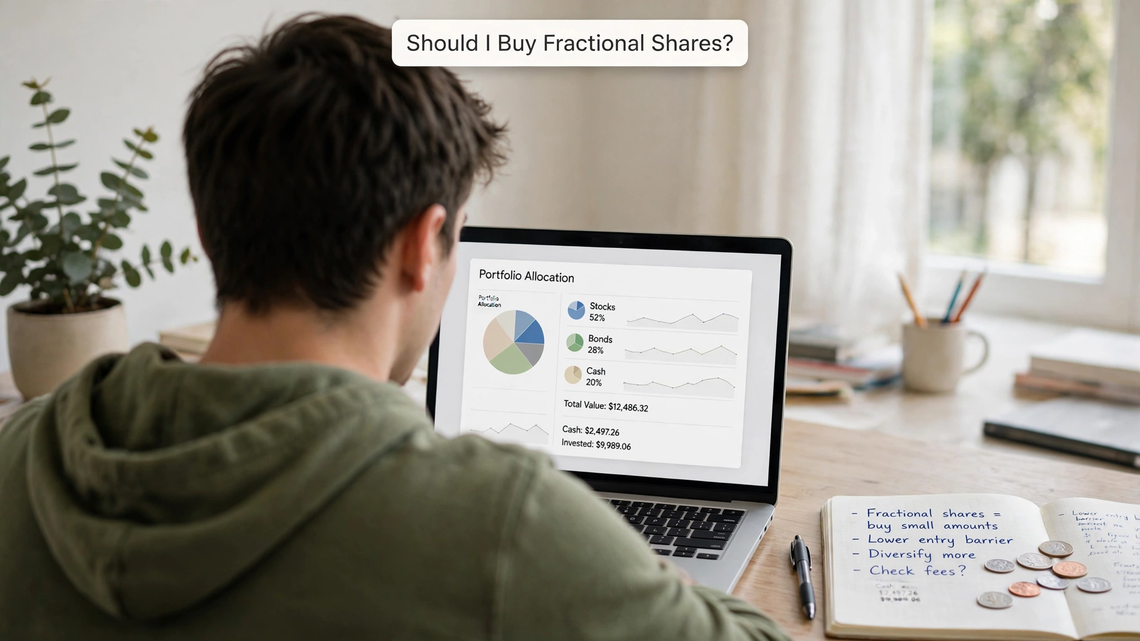
If you’re asking should I buy fractional shares, the answer is yes when you invest small amounts on a regular schedule and want a diversified, fully invested portfolio. Skip them if you expect to switch brokers, need to move holdings in kind, or plan to trade short-term price swings.
Key Takeaways
- A fractional share is a slice of one share, bought by dollar amount rather than by share count.
- Fractional investing keeps every contributed dollar invested, so high-priced stocks fit into small budgets.
- Most brokers cannot transfer fractional positions to another firm, so a switch in a taxable account usually forces a taxable sale.
- Each fractional purchase creates its own tax lot, and wash-sale rules apply to slices exactly as they do to whole shares.
- Fractional shares change the size of your position, not the risk of the company you own.
What Is a Fractional Share?
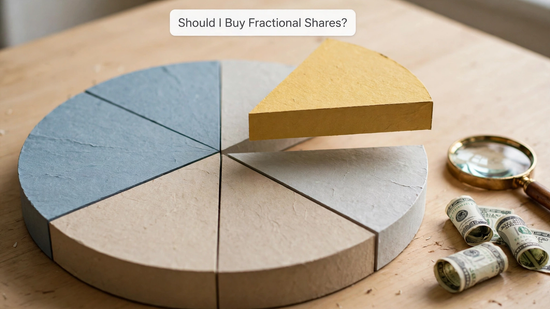
A fractional share is a piece of one stock share, such as 0.25 or 0.0731, that a broker carves out so you can invest a set dollar amount instead of buying whole units.
Behind the screen, your broker usually owns the full share and records your slice in its books. Many firms combine customer dollar orders and fill the fractions from their own inventory, which is why the slice can’t trade on an exchange by itself. You still get the price changes and dividends that match your slice.
Custody protection still applies. SIPC protects cash and securities held at a failed member brokerage up to $500,000, which includes a $250,000 limit for cash. That protection restores missing holdings if a firm collapses. It does nothing when a stock you picked falls 40%.
Should I Buy Fractional Shares? Who Benefits Most
Fractional shares work best for people who invest $25 to $500 at a time and want exposure to stocks priced far above that amount. Long-term, automatic investors gain the most. Active traders gain the least.
Sixty-two percent of U.S. adults reported owning stock in 2025, according to Gallup. That figure includes 401(k)s, IRAs, and mutual funds, not just individual company shares. So roughly 38% of adults hold no market exposure at all, and a $1 entry point removes the excuse that good companies cost too much per share.
Fractional buying also suits anyone following a fixed percentage plan. If your plan gives one company 10% of each deposit, dollar-based orders hit that 10% every time, whatever the share price. Ideas from stock-pick sites like 5starsstocks .com fit into the same system but give an unproven pick a small weight until you’ve checked its earnings, debt, and valuation yourself.
What Are the Pros of Fractional Shares?
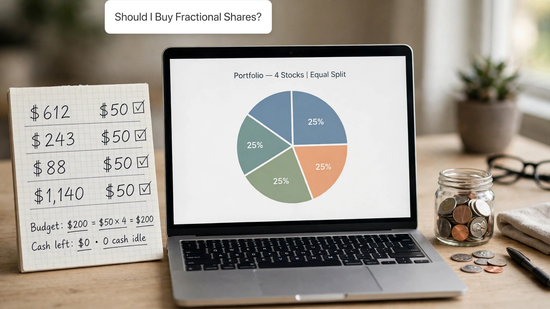
The main advantage is that idle cash disappears: every dollar goes into the market the day you invest it. A short example shows how much that matters.
Picture a $200 monthly budget split equally across four stocks priced at $612, $243, $88, and $1,140. A whole-share buyer can afford two shares of the $88 stock ($176) and nothing else. That leaves $24 in cash and a portfolio holding one company, while the $1,140 stock stays out of reach until month six.
A fractional buyer puts $50 into each stock on day one:
| Stock price | $50 buys | Whole-share buyer owns |
| $612 | 0.0817 shares | 0 |
| $243 | 0.2058 shares | 0 |
| $88 | 0.5682 shares | 2 |
| $1,140 | 0.0439 shares | 0 |
After one month, the fractional portfolio holds four companies with zero cash drag. The whole-share portfolio holds one.
Other benefits worth counting:
- Exact rebalancing: you can trim or add $12.40 to bring a position back to its target weight.
- Automatic dividend reinvestment: payouts buy partial shares right away instead of sitting as cash.
- Cheap testing: putting $20 into a new idea costs little if the thesis fails.
- Access to fractional ETFs: many brokers slice funds too, so a $15 deposit can buy a piece of a whole index.
Price stops dictating your choices. You can own the best stocks on your watchlist in the weights you planned, not the weights your account balance happens to allow.
What Are the Cons and Hidden Risks?
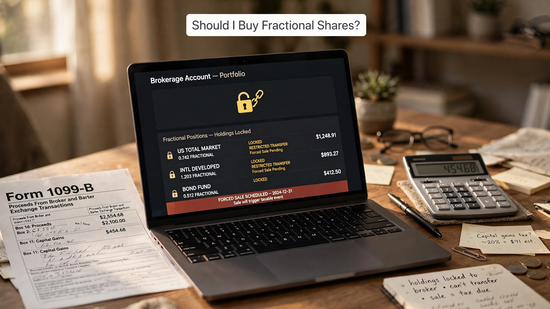
The biggest drawback is portability. Fractional positions are tied to the broker that created them, and leaving that broker usually means selling.
FINRA’s June 2025 investor insight on fractional shares says you can’t currently move them to another brokerage firm. Here’s what that costs. Suppose you hold 0.45 shares bought at $220 ($99 cost), and the stock now trades at $310, so the slice is worth $139.50. A forced sale realizes a $40.50 gain, and at a 22% short-term rate you owe about $8.91. Across 20 similar positions, a broker switch costs roughly $178 in unplanned tax.
Order, voting, and tax-record limits
Some brokers fill fractional orders only as market orders during regular hours, and some apps batch dollar orders and execute them at set times. Either way, you can’t lock in an exact price. Voting also varies: some firms pass votes along in proportion, while others give fractional holders no vote.
Taxes get busier too. A weekly $25 buy creates 52 tax lots a year in one stock. If you sell a slice at a loss while automatic purchases or dividend reinvestment buy the same stock within 30 days, the wash-sale rule disallows part of that loss.
Size doesn’t shrink risk
A $10 slice of a volatile cannabis grower swings by the same percentage as a full share. Small dollar amounts make speculative names feel harmless, and that feeling leads many beginners to stack up a dozen of them. Keep speculative positions under 5% of the account, whatever the slice size.
The mistake most beginners make
New investors often spread $100 across 30 stocks because the app makes it easy. Each holding gets $3.33. Tracking 30 cost-basis records for a $100 account adds paperwork without real diversification, and a single broad index fund would spread the money much further. The fix is to cap individual positions at 8 to 12 stocks and let a fund hold the rest.
What Happens to Fractional Shares in a Split or Dividend?
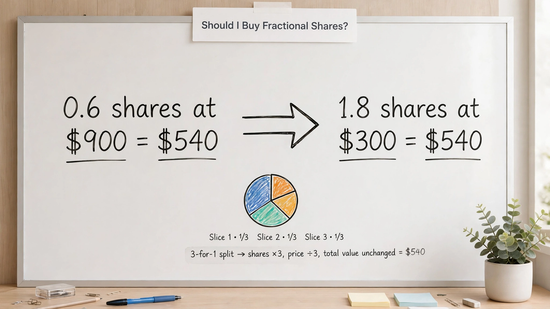
When a stock splits, your fractional holding multiplies by the split ratio, and its dollar value stays the same. Dividends arrive in proportion to the size of your slice.
Here’s what happens when a stock splits forward: if you own 0.6 shares at $900, worth $540, a 3-for-1 split leaves you with 1.8 shares at $300, still worth $540. Reverse splits work the other way. A 1-for-10 reverse split turns 0.5 shares into 0.05 shares, and investors at brokers that don’t support fractions get “cash in lieu” for the leftover piece, which counts as a sale for tax purposes.
Apex Fintech Solutions’ fractional trading disclosure states that it rounds fractional share values and dividend payments to the nearest cent. On tiny positions, that rounding shows. A 0.03-share stake in a stock paying $0.50 a quarter earns $0.015, which shows up as one or two cents. If you want dividend income that adds up, build each slice to at least $100.
How Do You Use Fractional Shares to Build a Portfolio?
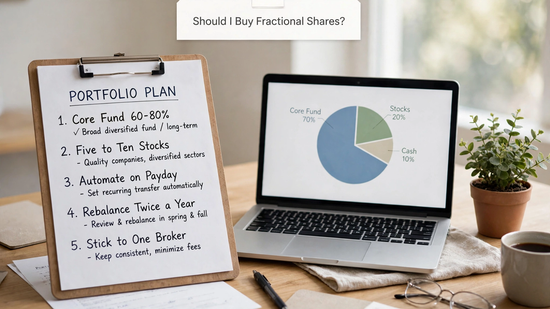
Use fractional shares for consistency: set a target mix, automate deposits, and let dollar-based orders keep each weight in place. For anyone researching how to build a stock portfolio for beginners on a small budget, this five-step method works with almost any amount.
- Pick a core fund first. Put 60% to 80% of each deposit into a broad index ETF that your broker sells in fractions.
- Add a short list of companies. Choose five to ten businesses you understand and assign each a fixed percentage.
- Automate the schedule. Set a recurring buy on payday so the same dollar amount goes in every month.
- Rebalance twice a year. Trim anything 5 points over its target and add to anything under it.
- Commit to one broker. Pick a firm you plan to keep for years, since leaving triggers sales of every fraction.
Compare brokers before step one, because minimums and eligible stock lists differ.
| Broker | Minimum per fractional order | What you can buy in fractions | Notable limit | Source |
| Fidelity | $1 | Eligible U.S. stocks and ETFs | Fractions can’t be transferred out | Fidelity, Fractional shares page |
| Charles Schwab | $1 | Most U.S. stocks and ETFs | Fractions can’t be transferred out | Charles Schwab, Fractional shares page |
| Robinhood | $1 | Stocks and ETFs | Stock must trade above $1 with a market cap over $25 million | Robinhood Learn, How to start investing for as little as 1 dollar |
Schwab’s $1 minimum now matches Fidelity and Robinhood, so the three brokers differ mainly on which stocks they cover, not on entry cost.
Can You Trade Fractional Shares Short-Term?
You can, but fractional shares are built for buying and holding, not for timing entries and exits. Order restrictions are the main obstacle.
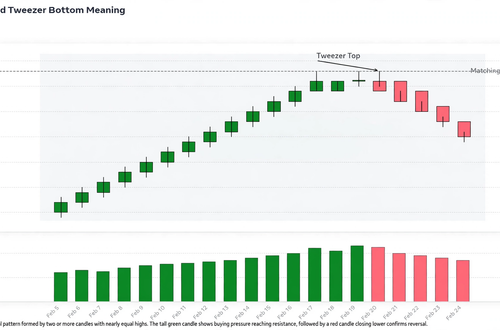
Chart traders who look up tweezer top and tweezer bottom meaning want to time reversals with candlestick patterns. A tweezer top is two candles with nearly matching highs after a rally, a hint that buyers are fading. A tweezer bottom is matching lows after a decline, a hint that sellers are running out. Acting on either signal calls for a limit order at a precise price, which many fractional programs don’t allow. Frequent selling also turns every gain into short-term income taxed at your ordinary rate.
When the Usual Advice Doesn’t Apply
Fractional shares are a poor fit if you invest $5,000 or more per deposit, mostly in ETFs priced under $100. At that size, whole shares leave less than 2% of each deposit as cash, so you gain almost nothing and keep full transfer rights. Retirement accounts flip the tax math the other way: when an IRA moves to a new broker, the forced sale of fractions creates no tax bill, so the portability penalty shrinks to a few dollars of lost market exposure for a week or two.
FAQ
Are fractional shares a good idea for beginners?
Yes, fractional shares suit beginners who invest small, regular amounts and want diversification right away. A $50 deposit can cover several companies. Pair the slices with a core index fund so money doesn’t scatter across dozens of tiny positions.
Do fractional shares pay dividends?
Yes, fractional shares pay dividends in proportion to the slice you own. A 0.25-share holding receives one quarter of the per-share payout, and most brokers can reinvest it automatically.
Can I sell fractional shares anytime?
You can sell fractional shares during the hours your broker supports them, usually regular market hours. The broker handles the sale internally, so you need its platform to exit.
What happens to fractional shares if I change brokers?
Your old broker typically sells the fractional portion and sends cash, while whole shares move over in kind. In a taxable account, that sale counts as a realized gain or loss.
Are fractional shares protected if my broker fails?
Yes, fractional positions at a member brokerage get the same custody protection as whole shares. That coverage replaces missing holdings after a firm failure. It never covers losses from falling prices.
Are fractional shares riskier than whole shares?
No, market risk is identical because a slice moves by the same percentage as a full share. The extra risks are practical: limited transfers, order restrictions, and less voting control.
Conclusion
Should I buy fractional shares? For most small, steady investors, yes, because every dollar goes to work immediately and expensive stocks stop being out of reach. Choose a broker you plan to keep, anchor the portfolio with a broad fund, and treat each slice as real ownership with real risk.